





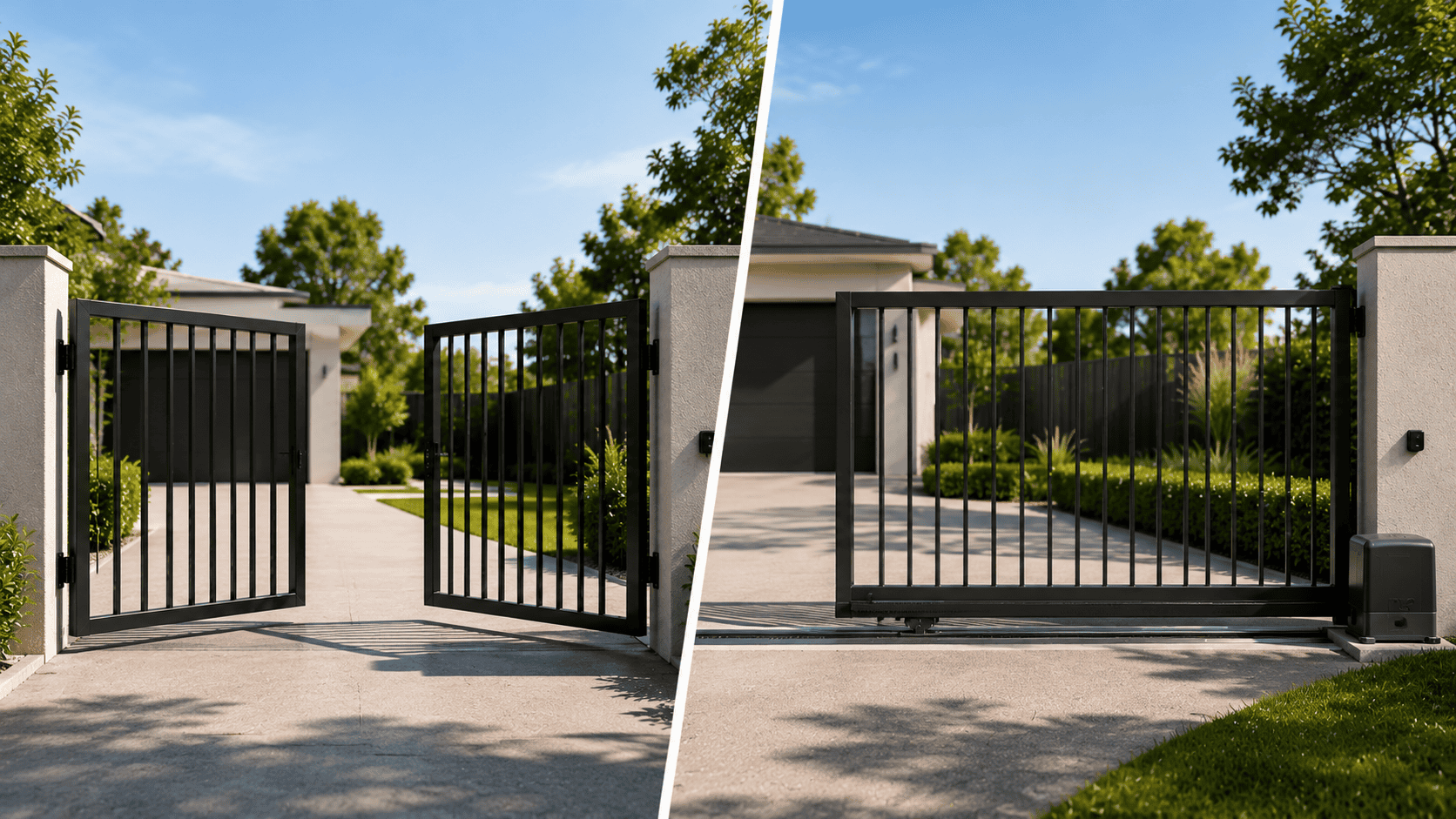
Automatic gates are now a key feature for both residential and commercial properties. They offer enhanced security, curb appeal, and convenient access control. Among the leading options are automatic sliding and swing gates. However, both have different functionality and their own set of pros and cons.
It is important to understand the differences between them so that you can make an informed decision for your property.
Understanding of Automatic Sliding Gate: Pros & Cons
- Operation:
An automatic sliding gate operates by moving horizontally along a track or rail system, typically parallel to the fence or wall. Earlier, it was done manually. Modern-day sliding gates are powered by an electric motor that slides open to allow vehicles or pedestrians to pass through. This design is particularly favoured in modern architecture for its sleek appearance and efficient space use.
- Installation:
Installation requires either a ground track or a cantilever system, which suspends the gate above the ground. Cantilever gates are advantageous because they avoid problems caused by debris and uneven surfaces. Industry experts note that sliding gates are often more durable in harsh weather, as their linear motion resists high winds better than pivoting gates.
- Security and Maintenance:
Automatic sliding gates offer enhanced security and are difficult to force open. They require little maintenance if the track remains clean. To prevent debris accumulation, tracks should be cleaned regularly. Otherwise, it may block the gates midway. Sliding gates support convenient automation features such as remote controls and smartphone integration.
- Cost:
However, depending on the materials and size, their initial cost is high. If the ground is uneven, additional engineering may be required before installation, potentially increasing installation costs.
Pros of Automatic Sliding Gates
- Space Efficiency:
They are space-efficient and do not require clearance space in front or behind the entrance. For narrow driveways, short approaches, or properties close to roads, automatic sliding gates are convenient.
- Enhanced Security:
Sliding gates have a robust, interlocking structure that makes them significantly harder to force open, ram, or lift. Their linear motion and solid anchoring provide better resistance against unauthorised entry.
- Better Performance in Windy Conditions
Because they move sideways rather than pivoting, automatic sliding gates experience much less wind resistance. This reduces stress on motors, hinges, and the overall structure, leading to greater stability and longevity in windy or coastal regions.
- Modern Aesthetics
The clean, linear movement gives a contemporary look that complements modern architecture.
Cons of Automatic Sliding Gates
- Higher Initial Cost
Automatic sliding gates are generally more expensive because they require a track system or a cantilever mechanism, stronger motors, and precise alignment.
- Requires Adequate Side Space
While they save space at the entrance, sliding gates need a clear run along the side fence or wall equal to the gate's width for full opening.
- Maintenance of Tracks
Gate tracks can accumulate leaves, dirt, sand, snow, or small debris in the rail, which may cause jamming or uneven movement if not cleaned regularly.
- More Complex Installation
Installation of automatic sliding gates requires proper levelling and foundation work for the track or motor. The electrical setup also requires skilled professionals. Mistakes during installation can lead to alignment problems, premature wear, or safety issues.
Insights of Automatic Swing Gates: Advantages & Disadvantages
- Operation:
Automatic swing gates operate like traditional doors, pivoting on hinges to open inward or outward. They use arm or linear actuators attached to the gate posts, creating a smooth arc motion. Swing gates are common in estates and suburban homes, providing a classic look.
- Installation:
Swing gates are available as single or double-leaf. The double-leaf models offer wider access for larger vehicles. Automation options include underground or above-ground operators, and solar compatibility for remote sites.
- Security and Maintenance:
Swing gates require clearance equal to their width to ensure unobstructed operation. In windy areas, swing gates can place stress on hinges, leading to faster wear. While maintenance is generally low, hinges and actuators need periodic lubrication to prevent squeaking or failure.
- Cost:
It is less expensive than sliding gates owing to its simple design. Besides, they open more quickly and also offer decorative customisation for some setups.
Pros of Automatic Swing Gates
- Lower Cost
Swing gates are a budget-friendly option in comparison to sliding gates. Both the gate panels and the automation kit cost less.
- Simpler Installation
The installation process of the automatic swing gate is quick and simple. It does not require a track or cantilever foundation.
- Quieter Operation
Swing gate motors tend to be noticeably quieter than sliding gate motors, which generate more mechanical noise from rollers or tracks. A swing gate ensures that early-morning or late-night gate movement does not disturb neighbours.
- Easier Maintenance
As swing gates have fewer exposed moving parts, routine maintenance is mostly limited to occasional greasing of hinges and pivots, and checking actuator arms. This makes them lower-effort for many homeowners compared to tracked sliding systems.
Cons of Automatic Swing Gates
- Requires Significant Clearance Space
Each leaf needs an arc roughly equal to its own width to open fully. This limitation makes swing gate usage impractical on narrow driveways, short approaches, or plots right up to the road.
- Less Secure
Light-weight swing gates are easy to force open or ram. However, due to automation, the possibility of forced intrusion is substantially low.
- Less Functional in High-Wind Areas:
Swing gates are more vulnerable in gusty conditions where wind can put stress on hinges, arms, and motors. This can lead to faster wear, misalignment, or even damage if not reinforced.
- Pinch and Crush Zones:
While modern openers include obstacle detection, children, pets, or vehicles stopping too close can still be at risk if sensors are obstructed or fail. This creates a risk of pinching or crushing.
Sliding Gate Vs Swing Gate: Identifying the Difference
Choosing your driveway gate
Sliding Gates vs Swing Gates
| Aspect |
Sliding Gate
Automatic
|
Swing Gate
Automatic
|
|---|---|---|
|
Space Requirements
|
Requires side space for sliding; ideal for short driveways. | Needs front or back clearance for swinging; better for spacious entrances. |
|
Cost
|
Higher upfront cost and complex installation. | Lower cost and simpler setup. |
|
Security
|
Superior; difficult to ram or force open. | Good, but more vulnerable to impact. |
|
Durability in Weather
|
Excellent in wind; less affected by elements. | Can be swayed by strong winds; potential for damage. |
|
Maintenance
|
Tracks need cleaning; occasional motor checks. | Hinges and arms require lubrication; fewer issues overall. |
|
Aesthetics
|
Modern, sleek look; often grander. | Traditional, elegant; customisable. |
|
Automation Ease
|
Compatible with advanced systems; faster for wide openings. | Straightforward; integrates well with smart homes. |
MLR Engineering for Custom-made Automatic Gates
It is best to consult a professional installer to assess your specific needs. MLR Engineering is known for high-quality solutions in the design, manufacturing, and fitting of custom-made gates across Dapto, Kiama, Wollongong, and Shellharbour.
Operating since 1996, we proudly manufacture, supply and fit custom-made automatic gates, aluminium gates, pool fences, balustrades, handrails, and privacy screens.
Consult our experts for customised automatic sliding gates and swing gates.
MLR Engineering for Custom-made Automatic Gates
What are the main differences in installation costs between automatic sliding gates and automatic swing gates?
Automatic sliding gates generally cost more to install due to the track system, while swing gates are cheaper because of simpler mechanics and a hassle-free installation process.
Which type of automatic gate is more secure?
From a security POV, sliding gates are often considered more secure as they resist forced entry better than swing gates, which can be more susceptible to ramming.
Which is the best space-saving automatic gate?
For properties with limited space, automatic sliding gates are ideal because they do not require the arc space needed for swing gates. This makes them suitable for urban homes with short driveways or properties near public roads in Dapto, Kiama, Wollongong, Shellharbour where an outward swing could block traffic.
Which is the best electric gate for sloped driveways?
Sloped driveways require careful gate selection to ensure reliable operation. Automatic sliding gates, especially cantilever models without ground tracks, are often recommended for inclines because they avoid clearance issues and can be designed to follow the slope. Swing gates can be fitted with rising hinges to accommodate gradients, but on steep slopes, they may require more space and can strain motors if not properly set up. A professional assessment is recommended to evaluate slope and soil stability.
Which is the best automatic gate for narrow entrances?
Narrow driveways require gates that maximise access and security. Automatic sliding gates are usually best for narrow entrances, as they open without needing extra width. They are ideal for entrances under 10 feet wide, where swing gates are impractical. While single-leaf swing gates are possible, they often need more space. For very narrow spaces, telescoping sliding gates that stack panels provide even greater efficiency.